Never-Ending Western Film Set
The Robot Who Looked Like MeThe Never-Ending Western Film Set is the immense landscape behind America’s ongoing Western, a production space whose frontier begins at a plain pinewood station and stretches across prairie, mountains, and desert. Its defining feature is the uneasy threshold between contemporary infrastructure and a Western world made to be performed for real: the setting is not merely a backdrop, but a monitored environment in which actors enter the fiction and audiences watch them inhabit it.
Boundary and Access
The Set is reached from State Highway 101 by a rutted dirt road that ends at the Wells Fargo Station. The low, unpainted pinewood building marks a sharp division: on one side is twenty-first-century America, described as recycled and reprocessed; on the other lies the million-acre expanse assigned to the Western. The station is therefore both a practical entrance and a visible threshold between the modern world and the historical fiction beyond it.
The boundary is also a point of preparation. Before crossing it, Washburn is checked by an assistant director for anachronisms, including a wristwatch, and is told he may go through when ready. His costume and period equipment have already been arranged, with a horse and blanket roll waiting beyond the station. This procedure makes the transition legible: the actor does not simply arrive in a town dressed for the part; he is inspected at the edge of the production and then passes into its territory.
A Monitored Western Landscape
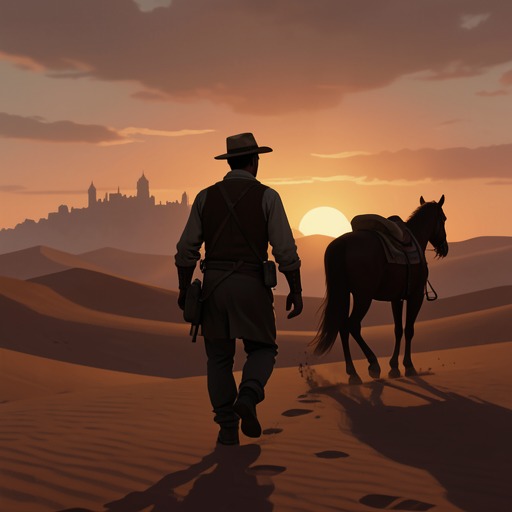
Beyond the station, the Set encompasses prairie, mountains, desert, and a network of concealed cameras and microphones. Its scale allows the performance to unfold across a landscape rather than within a conventional enclosed stage. Washburn’s route carries him through striped canyon walls, up to a high saddleback between two mountains, and down toward a small settlement. The scenery is presented in successive views, from a distant rider moving across the terrain to a figure silhouetted against the evening sky and setting out again at sunrise.
The settlement of Comanche supplies a concentrated image of the Western town within this larger expanse. Its single Main Street contains a saloon, boarding house, livery stable, blacksmith’s, and general store. Dust lies over the buildings, and the desert wind moves through the street. These details give the town the appearance of an old photographic image, while its place within the monitored territory connects even its seemingly self-contained street to the production surrounding it.
The Set as Performance Space
The Never-Ending Western Film is not made according to a fixed script. Washburn returns from retirement for a cameo under a no-kill contract, expecting to improvise with Old Jeff Mangles and Natchez Parker around whatever situations arise. The Set provides the ground on which that unscripted action can take shape: its town, trails, and open country are not simply painted scenery but the spaces through which performers move and the cameras follow them. The account contrasts this method with the staged productions familiar to Consuela, who has worked in Gaucho dramas filmed in Buenos Aires and Montevideo and struggles to understand why an American Western must be done for real when its effects could be contrived.
The station’s position between the modern world and the frontier makes the production’s division between off-camera life and performance visible. Washburn arrives in an air-conditioned Cadillac with his agent-manager, Gordon Simms, and Consuela; Simms talks business, while Consuela is quiet and apprehensive about the Set. Their departure from him at the station frames entry as a separation from his contemporary life. Once he crosses the building, the narrative shifts from arrival and preparation to the long ride through Western terrain.
Viewers, Actors, and the Frontier Image
The hidden recording equipment links the physical landscape to its audience. The camera can follow Washburn from a distant figure among canyon walls to a rider moving through a settlement, while viewers encounter the journey through the finished sequence of images. Yet the narration complicates the distance between performer and spectator: Washburn describes himself as watching himself act even as he acts, and recognizes that the heroic image he sees is also the one presented to viewers. The Set thus supports two simultaneous experiences of the Western—participation in its terrain and observation of that participation as a screen performance.
That doubleness also sharpens the meaning of Washburn’s return. His first-person account describes a famous performer whose earlier years in the Movie have ended, and whose cameo does not deliver the grand final gunman’s scene he and Simms once wanted. The station and the road beyond it make this return tangible: he leaves the contemporary car and his companions behind, crosses into the familiar landscape, and resumes a role that is at once lived and watched. The Set’s significance lies in making that passage possible while exposing the machinery of the frontier image through which it is seen.